Planning to Start Your Own Clinic in Kolkata? A Complete Guide Before You Invest
Starting your own clinic is an exciting step for any doctor. But a successful clinic is not built only around medical expertise. Location, patient catchment, property, licensing, infrastructure, business structure, accounting, working capital and revenue planning all play an important role.
Before signing a lease, purchasing a property or investing in equipment, it is important to evaluate the complete business plan.
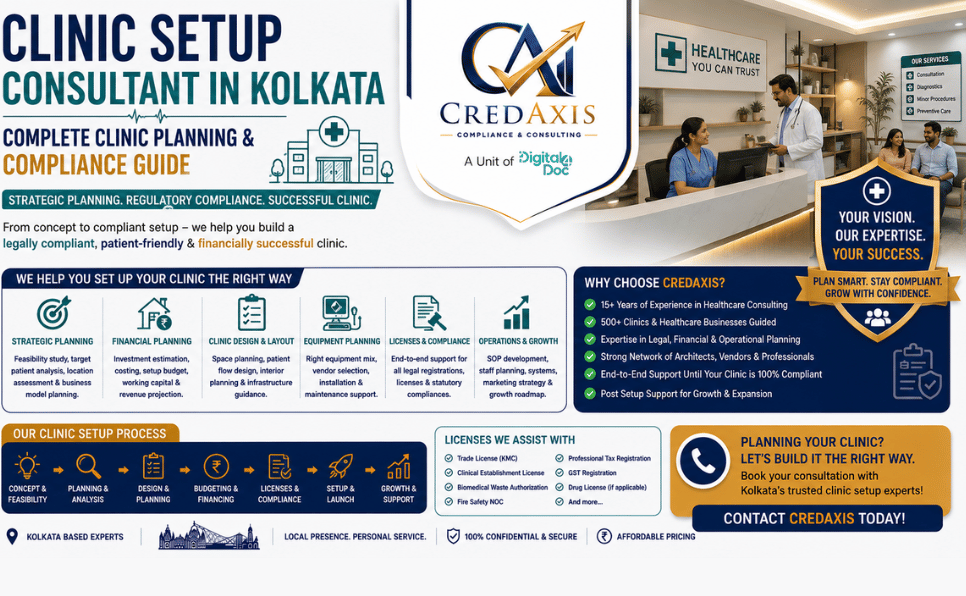
At CredAxis – Compliance & Consulting, we help doctors and healthcare professionals plan their clinic setup with a practical approach covering business, property, licensing and compliance requirements.
1. When Should You Start Your Own Clinic?
The first question is not “Where should I open my clinic?” but “Is this the right time?”
Consider:
Your existing patient base
Professional experience and reputation
Availability of time to manage the clinic
Financial capacity
Competition in your speciality
Expected patient volume
Scope for future expansion
Whether you want a consultation practice or a larger healthcare setup
Starting too early without sufficient patient demand can create unnecessary financial pressure. Waiting too long can also mean missing an opportunity in a growing market.
A proper feasibility assessment can help you determine whether the proposed clinic is commercially viable.
2. Where Should You Open Your Clinic?
Location can directly influence patient footfall.
In Kolkata, areas such as Salt Lake, New Town, Rajarhat, Ballygunge, Garia, Behala, EM Bypass and other established residential and commercial zones can have very different patient profiles and property costs.
Before selecting an area, study:
Target patient catchment
Population and demographics
Existing healthcare facilities
Nearby hospitals and diagnostic centres
Accessibility by road and public transport
Parking availability
Visibility and accessibility of the premises
Competition within your speciality
Future development of the locality
The best location is not necessarily the most expensive one. It is the location where your target patients can conveniently access your services and the economics make sense for your practice.
3. Rent or Purchase – Which is Better?
One of the biggest decisions is whether to rent or purchase the clinic premises.
Renting may be suitable when:
You are starting with limited capital
You want flexibility
You are testing a new location
You want to preserve working capital
You expect to expand or relocate later
Purchasing may be suitable when:
You have sufficient capital
You plan to operate from the location for many years
The property has strong long-term value
You want greater control over the premises
Do not compare only monthly rent with property price. Consider security deposit, registration costs, renovation, maintenance, financing costs, property appreciation, taxes and opportunity cost of capital.
4. Verify the Property Before Signing
If you are purchasing or leasing a property for a clinic, property verification should be completed before making a major financial commitment.
Check:
Ownership and title documents
Mutation records
Property tax and assessment records
Approved building plan
Existing use of the premises
Whether healthcare use is permissible
Occupancy and completion-related documents
Applicable municipal permissions
Land and building-related restrictions
A property that appears suitable from the outside may not necessarily be legally or practically suitable for your proposed healthcare activity.
5. What Services Will Your Clinic Offer?
Your service model determines your infrastructure, investment and compliance requirements.
Decide whether you will provide:
Consultation Only
A comparatively simple model focused on doctor consultation.
Consultation + Procedures
May require additional rooms, equipment, trained staff and applicable approvals.
Consultation + Diagnostics
May require additional equipment and specific regulatory requirements depending on the diagnostic services.
Speciality or Multi-Service Clinic
A broader model may require significantly higher investment and more extensive compliance.
For example, an IVF centre, diagnostic centre, dental clinic, day-care procedure centre and general consultation clinic will have very different infrastructure and licensing requirements.
6. Plan the Facilities Before Interior Work
Do not begin interior work without understanding the operational requirements of the clinic.
Plan for:
Reception
Waiting area
Consultation rooms
Procedure rooms, where applicable
Patient and staff circulation
Washrooms
Storage
Medical equipment
Electrical requirements
Ventilation and air-conditioning
Biomedical waste handling
Fire safety
Accessibility
Staff facilities
The layout should support efficient patient flow, privacy, safety and future expansion.
7. Which Licences and Approvals Are Required?
Healthcare establishments may require multiple registrations and approvals depending on their services, location and structure.
These may include:
Clinical Establishment registration/licence
Trade Licence
Fire-related approval/NOC
Pollution Control permissions
Biomedical Waste-related compliance
PCPNDT registration for applicable diagnostic services
ART registration for applicable fertility and IVF services
Pharmacy-related licence, where applicable
Drug-related licences, where applicable
Building and municipal approvals
Other service-specific permissions
Not every clinic requires every licence. The applicable approvals should be determined based on the actual services, premises and proposed operations.
8. Choose the Right Business Structure
Before starting operations, decide how the clinic will be legally structured.
Common options include:
Proprietorship
Suitable for an individual doctor operating a practice in their own name or as a sole business.
Partnership
Useful where two or more professionals jointly operate the business.
LLP
Provides a structured partnership model with limited liability and separate legal identity.
Private Limited Company
Can be considered where the business is designed for structured expansion, investment, multiple stakeholders or larger operations.
The right structure depends on ownership, investment, liability, taxation, expansion plans and the long-term objectives of the practice.
9. Don’t Ignore Accounting & Tax Planning
A clinic is also a business and requires proper financial management from day one.
Your planning should include:
Bookkeeping
GST applicability assessment
TDS compliance
Income-tax return
Payroll management
Professional receipts and expense tracking
Monthly accounting
Financial statements
Cash-flow monitoring
Proper accounting helps you understand whether your clinic is actually profitable—not simply whether money is coming into the bank account.
10. Calculate the Total Investment
Do not estimate your investment based only on interior cost + equipment.
Your financial plan should consider:
Initial Setup Cost
Property deposit or purchase
Interior and civil work
Furniture
Medical equipment
IT systems
Signage
Licences and registrations
Professional fees
Monthly Operating Expenses
Rent or EMI
Salaries
Electricity
Internet and software
Consumables
Housekeeping
Maintenance
Accounting and compliance
Marketing
Working Capital
Keep sufficient funds to operate the clinic during the initial period when patient volumes may still be developing.
11. Estimate Expected Revenue
Before investing, prepare a realistic revenue projection.
Consider:
Expected Patients × Average Revenue per Patient = Estimated Revenue
Then compare the projected revenue with your monthly operating expenses.
Also consider:
Consultation fees
Procedure revenue
Diagnostic revenue
Package revenue
Doctor availability
Expected patient growth
Seasonal variations
Referral sources
Avoid assuming that the clinic will immediately reach its target patient volume. Build conservative, realistic and optimistic scenarios.
The Clinic Should Be Planned as a Business
A successful clinic requires more than a good location and attractive interiors.
You need to answer:
WHEN?
Is this the right time to start?
WHERE?
Which location offers the right patient catchment?
RENT OR PURCHASE?
Which option makes financial sense?
WHAT SERVICES?
What exactly will you offer?
WHAT FACILITIES?
What infrastructure and equipment are required?
WHICH LICENCES?
Which regulatory approvals apply?
WHAT ENTITY?
Proprietorship, Partnership, LLP or Private Limited?
WHAT ACCOUNTING SYSTEM?
How will your accounts, GST, TDS, payroll and taxation be managed?
WHAT INVESTMENT?
How much capital and working capital will you actually require?
How CredAxis Can Help
At CredAxis – Compliance & Consulting, we help doctors and healthcare entrepreneurs evaluate the requirements of a proposed clinic before they make major investments.
Our support can cover:
Clinic Setup Planning
Property & Location Assessment
Property Documentation & Verification
Business Entity Formation
Healthcare Licensing
Municipal Approvals
Regulatory Compliance
Accounting & Tax Support
Documentation & Application Assistance
From property selection to licensing and ongoing compliance, our objective is to help you build a clinic that is not only medically capable but also legally compliant and financially planned.
Don’t Just Open a Clinic. Plan the Business Behind It.
Before signing a lease, purchasing a property or starting construction, take a step back and evaluate the complete setup.
A well-planned clinic can reduce unnecessary investment, avoid compliance problems and create a stronger foundation for long-term growth.
Book a One-to-One Clinic Planning Consultation
CredAxis – Compliance & Consulting
📞 +91 98313 55912
🌐 www.hospital4doc.com
Plan Better. Comply Better. Build Your Healthcare Business with Confidence.